
Choosing your equipment
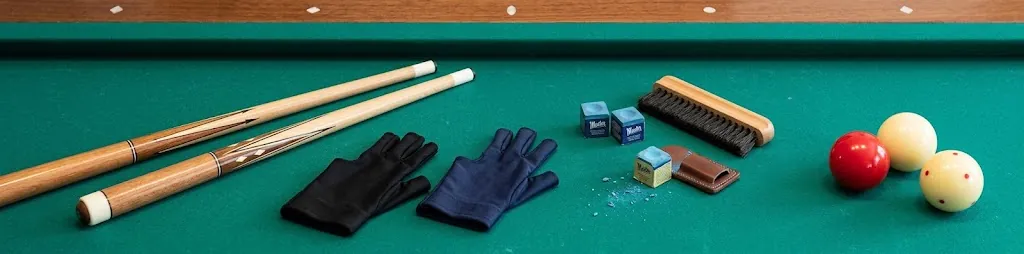
Technique matters more than equipment: a good cue doesn't fix bad fundamentals. But once the basics are in place (see Basic technique), a few concrete choices — the tip, the chalk, the cue's weight — change how comfortable the game feels and, with experience, how precise your spin becomes.
⎙ My shopping list, printable One A4 page by level, with tick boxes.
Three levels, three budgets
There is no "ideal" cue in absolute terms: there is the one that matches what you do. Here are three profiles, with what is worth paying for in each — and what is not. Prices are indicative ranges, noted in October 2026 across several specialist online shops: they vary from one shop and one season to another, so check before buying. The brands mentioned are not partners of this site (see the note further down).
Casual: I mostly want to play
About €40 to €100 for a complete cue.
A simple wooden cue (maple or ash), industrially made, with a basic tip and finish. Common brands: Buffalo, Dufferin (entry-level models), or the cheapest cues in specialist shops. Ordinary chalk is enough, and a club cue you can borrow lets you try before you buy. The only real check: that it is straight (roll it on a flat surface).
Not worth paying for: decorative finishes, which won't make you play better at this stage.
To be ready to play
- Cue: Buffalo Triton S3(affiliate link) (about €65) or Adam Orca S2(affiliate link) — two entry-level 2-piece carom cues.
- Chalk: pack of 4 at Decathlon(affiliate link) (about €6).
- Glove (optional): see at Decathlon(affiliate link).
Club: I'm getting into it, I play regularly
About €100 to €300 for the cue.
Better-selected and more consistent wood, a more reliable shaft, a careful finish, sometimes adjustable weight. This is the level where a good multi-layer leather tip starts to matter (diameter around 11 to 12 mm). Common brands: Adam, Longoni (entry ranges), and Buffalo or Dufferin in their upper models. A carrying case becomes useful.
Good habit: try several cues at a club or in a shop before choosing — the feel in your hands matters more than the product sheet.
To be ready to play
- Cue: Buffalo Maxton Minerva no. 3 (490 g, 11 mm)(affiliate link) or no. 1 (500 g)(affiliate link) (about €110) — choose the weight by trying.
- Chalk: Kamui(affiliate link) or Taom(affiliate link) (see "The chalk" below).
- Case: see on Amazon(affiliate link).
- Glove (optional): see at Decathlon(affiliate link).
Competition: I play tournaments
From about €300 for the cue, up to several thousand euros for top-end models.
Very carefully selected wood, advanced manufacturing and calibration, adjustable weight and balance, a quality tip, often a 3-piece cue for transport and a spare shaft. Common brands: Longoni, Molinari, Caudron, Adam (high-end ranges).
Worth knowing: the carbon shaft, increasingly common at this level, costs noticeably more (see below).
To be ready to play
- Cue: from a specialist shop or a club, after trying — at this level the models (Longoni, Molinari, Caudron, high-end Adam) are not sold by our two partners, so there is no link here.
- Spare shaft: see on Amazon(affiliate link) — pick one that fits your cue's joint.
- Chalk: Kamui(affiliate link) or Taom(affiliate link).
- Case: see on Amazon(affiliate link).
What makes the difference in quality
What drives up the price of a cue is not always what makes you play better. Here is what really changes something, from most to least important:
- The wood and its stability: a shaft made of dense maple, dried evenly, stays straight over time; standard or poorly dried wood can warp. This is what separates entry level from the rest most clearly.
- How the shaft is built: on higher-end models it is machined more precisely and sometimes reinforced (several pressed pieces, a fibre or carbon core) to limit ball deflection and vibration. The joint, made of wood on a carom cue, also has to be fitted precisely.
- The tip: a soft tip gives more control and spin but flattens faster and needs reshaping; a hard tip lasts longer and feels crisper, for a more aggressive game; a medium tip is a good compromise for starting out. As for construction, single-layer leather gives a natural feel, while several layers of compressed leather are more consistent and longer-lasting. An entry-level tip costs a few euros and is replaced often; a good tip costs over €15.
- Weight and balance: the right weight is the one that suits you (see below); on high-end cues, adjustable weight lets you fine-tune it.
- Decoration: inlays of precious wood (ebony, zebrawood), marquetry, hand finishing. This is mainly aesthetic: a significant part of the price of a top-end cue doesn't buy any extra precision.
What about carbon? A carbon shaft aims for less deflection and better consistency, especially on powerful shots. In return, the sound and feel at impact are different, you often have to relearn your aim, and the price is high: roughly €480 to €650 for the shaft, versus €300 to €400 for a good wooden one. Best kept for people who already play a lot — it is not a first purchase.
Our rule of thumb: move up a level when you feel a limit, not before. Start at Casual or Club depending on how often you play, try before you buy (a club lends cues: see Find a club), and keep room in the budget for lessons.
The tip
This is the leather disc glued to the end of the shaft: it's what touches the ball, and its condition governs the grip as much as the chalk does. In French billiards, its diameter runs around 10 to 12 mm — noticeably thinner than in American pool (12-13 mm), for a more precise contact with the cue ball.
- Wider diameter (12 mm): more forgiving on centring the strike, well suited for starting out.
- Thinner diameter (10-11 mm): allows more precise contact for calibrated side spin (like the tip of side spin in System 4), but forgives an off-centre strike less.
A tip wears down and flattens with play: it needs to stay slightly domed to grip the ball across its whole contact surface, not just at the centre. A shaping tool (tip shaper) and a bit of fine-grain sandpaper are enough to maintain it; past a certain point of wear, it gets replaced, which a club or a specialist retailer does in a few minutes.
The chalk
Chalk creates the grip between the tip and the ball: without it, an off-centre contact slips (the miscue mentioned in the Rules of the game). It's applied before any shot that departs from the natural stroke — side spin, reduced ball fullness, speed — with a light, circular motion, without forcing it.
Master and Triangle are also sold at Decathlon (a French sports retailer), alongside entry-level chalk brands: see the chalk at Decathlon(affiliate link)
The cue's weight
A French billiards cue generally weighs between 480 and 540 g, for a standard length of 140 cm. There's no "correct" weight in absolute terms: heavier, it carries a stroke better with less muscular effort on firm shots; lighter, it favours a finer touch on restrained shots. The only reliable way to know which suits you is to try several at a club or a shop — the weight listed on a product sheet doesn't replace the feel in hand.
Additional weight (balance screw)
Many mid-range and high-end cues have a system of interchangeable weights housed in the butt: you unscrew the rubber bumper, remove or add one or more weights (typically from 2 g to over 50 g each, depending on the set sold), and screw it back on. This lets you fine-tune the balance of a cue you already own — useful as your game evolves — without replacing it. Not every cue has this: it's worth checking before buying if this adjustment matters to you.
These brand references reflect positioning widely recognized in the carom billiards community, not a partnership or a test carried out by this site. Some links on this page are affiliate links (marked "affiliate link"): Amazon and Decathlon (through Rakuten Advertising) pay us a small commission on a purchase made after a click, at no extra cost to you. The brands and products recommended remain independent choices, made before and independently of any partnership.
Useful accessories
- Chalk holder: keeps you from losing the chalk or leaving it lying on the table. See on Amazon(affiliate link)
- Glove: mainly useful in hot weather or with a sweaty hand, to keep a steady bridge; not essential. See on Amazon(affiliate link) See at Decathlon(affiliate link)
- Extension: for balls too far away to hold a normal bridge, without climbing onto the table. See on Amazon(affiliate link)
- Case: protects a 2- or 3-piece cue for transport to a club or a competition. See on Amazon(affiliate link)